Mountain Springs Lake Siding
June 8, 2002
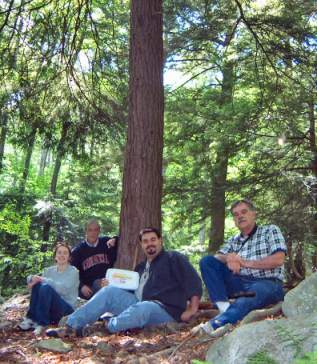
Holly (Peach), Your Webmaster (me), Sloan(ster) and Jim (JR) posing victoriously, having discovered the elusive cache!
Jim provided the Geographic Positioning System, without which, this expedition would not have been possible.
I had been to Mountain Springs Lake perhaps three times before, and
I was delighted to discover that a geocache had been placed there -
and a fairly recent one at that. It is a wonderfully remote and beautiful
spot. It's principle claim to fame is that it was the center of the
ice-cutting industry in the region, from about the turn of the century
until 1948, when mechanical refrigeration finally caused the industry
to, well... melt away.  It
is approached, most commonly, from a dirt road that splits off from
Rte 487, a few miles north of Lake Jean, at the top of Rickett's Glenn
State Park. But for many years, the only way to get there was by rail,
along the Bowman's Creek Railroad, from Noxen, 13 miles downstream.
It
is approached, most commonly, from a dirt road that splits off from
Rte 487, a few miles north of Lake Jean, at the top of Rickett's Glenn
State Park. But for many years, the only way to get there was by rail,
along the Bowman's Creek Railroad, from Noxen, 13 miles downstream.
Access is quite feasible in any reasonable vehicle, except, perhaps in very wet weather. One passes through a swampy and wooded area and eventually descends into a parking area at the end of the lake. On this 80° day, there were but two cars in the parking area, and in the two hours we were there, we saw only four people, and all but one of them at quite a distance. A brief but friendly conversation with a lady sitting on the dam fishing, suggested that the fishing was not the attraction she had hoped.

The view from the railroad siding that travels the length of the lake
and beyond.
 |
 The lake is nicely unspoiled. |
 |
|
|
||


One needs to watch where one steps... This little guy was about the size of a quarter and exactly the color of his surroundings. This miracle of nature is clearly his only defense, for he held perfectly still for his portrait sitting. We saw a number of these tiny toads along the trail, one large frog at the edge of the lake, two ducks and a deer on the ride in. We did not, I am happy to say, encounter any rattlesnakes, for this mountain is the source of the famed annual Noxen Rattlesnake Roundup. |
|
There are plenty of reasons of a more pleasant nature
for watching one's step - unusual little |
 orange
dandelions,and scattered wild strawberry
orange
dandelions,and scattered wild strawberry  blossoms
that mostly hide beneath the expanse of very promising blueberry
bushes that flourish in the open sunlight around the lake. You
can wander through these varieties of flora and fauna, completely
unaware of the fact that the backbreaking work that took place
where you are walking supported a village with a boarding house,
a few homes and a school. All that remains of this ghost town
are a few foundation pillars
blossoms
that mostly hide beneath the expanse of very promising blueberry
bushes that flourish in the open sunlight around the lake. You
can wander through these varieties of flora and fauna, completely
unaware of the fact that the backbreaking work that took place
where you are walking supported a village with a boarding house,
a few homes and a school. All that remains of this ghost town
are a few foundation pillars and the remnants of the railroad bed and bridges. The definitive
history of the remarkable era of ice-cutting and lumbering in
the region of North Mountain can be found in Ghost Towns of
North Mountain - Ricketts, Mountain Springs, and Stull, by
F. Charles Petrillo, published in 1991 by, and hopefully still
available at, the
and the remnants of the railroad bed and bridges. The definitive
history of the remarkable era of ice-cutting and lumbering in
the region of North Mountain can be found in Ghost Towns of
North Mountain - Ricketts, Mountain Springs, and Stull, by
F. Charles Petrillo, published in 1991 by, and hopefully still
available at, the  Departing
the lake via the access road, one is soon offered the temptation to
take a hard right and swing up onto the old railroad bed. A Park Service
sign bills this as a "snowmobile" route, but I prefer to think
of it as a cross-country skiing or bicycle trail, depending on the weather.
In fact, it is quite passable by car, although I wouldn't try it in
a Miata. It is quite rewarding on a fine day.
Departing
the lake via the access road, one is soon offered the temptation to
take a hard right and swing up onto the old railroad bed. A Park Service
sign bills this as a "snowmobile" route, but I prefer to think
of it as a cross-country skiing or bicycle trail, depending on the weather.
In fact, it is quite passable by car, although I wouldn't try it in
a Miata. It is quite rewarding on a fine day.
Following the path of Bowman's Creek as it gather's strength, the railroad line ran from the Wyoming Valley, out through the mountains past Harvey's Lake to the tannery town of Noxen, and on up into the hills of these ghost towns to Towanda and Upstate New York. One push on the pedal of a bike would start you on an easy glide through 13 miles of beautiful forest land until you glide approach into Noxen, where you are greeted back to civilization (although there are those who would dispute this), by a remarkable white horse, concluding a most successful day!
With many thanks to Michelle Hryvnak for introducing me to geocaching, and to my fellow searchers, Holly, Sloan and Jim, whose arms I did not have to twist very hard. |
 |
© Frank Burnside Jr. 2002