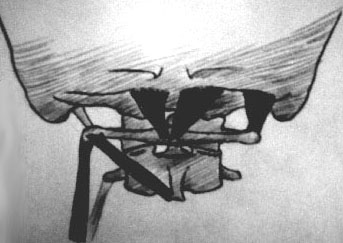
(Do this bilaterally using both hands simultaneously). Find the osseus landmarks which you will use as reference points for your palpation.
Check the relationships of the associated (or relevant) osseous landmarks, such as the spinous process to transverse process relationship.
Find the presumed angle or structural position of the muscle to be palpated.
Run your index fingers across the course of the muscle slowly back and forth.
Don't use too much pressure!
If similar bands of this muscle should be present in the adjacent vertebra then move on to that vertebra as you ascend the spinal column (assuming you have started with T-10 or T-11, which is an easy area to palpate).
If you are studying muscles unique to a particular area of the spine
such as the superior obliques or the gluteus maximus muscles then compare
one muscle to the other of the pair. For instance, compare the left
superior oblique to the right oblique, but if you are studying the levator
scapulaeor the multifidus muscles, for example, which attach to more than
one vertebra, then compare from side to side as well as the ascending bands.
Compare this next pair of muscles with the two you palpated below in the
same manner. Do you note any differences in the sensation these two sets
of muscles (if you have found a difference, do not jump to any conclusions).
Practice this exercise over and over until you are familiar with the
characteristic feel of all the different muscle described in the worksheets
(this will take four to six weeks if done properly). Try to use a
variety of patients.
As you feel confident in your knowledge of these muscles, begin to apply them to a clinical analysis. The adjustment is made in cooperation with the body’s own efforts; allowing for a more specific and gentler adjustment.
Again, remember that you are trying to identify specific muscle bands that are working for correction of a misalignment. For this reason the distinct location characteristic of the muscle must be noted before any attempt is made to interpret between tone of the muscle and tension of the working muscle.
Only one muscle occupies any one particular space between its origin and insertion. To then palpate for a specific muscle you must begin by palpating between the origin and insertion. Trace the distinct course of this muscle.
Skills are learned by trial and error, with error eventually decreasing.
Practice step by step until each muscle is mastered. Maintain
your initial enthusiasm. Watch for plateaus in learning.