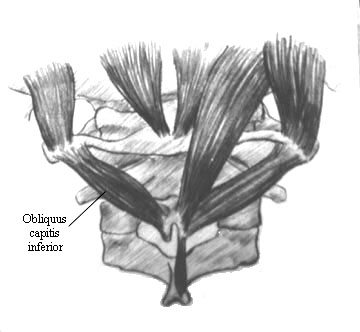
Origin: The spinous process of the axis vertebra.
Insertion: The transverse process of the atlas vertebra (running slightly upward and lateral toward its insertion).
Located: Within the posterior region of the neck, the obliquus capitis
inferior is most often palpable midway between the spinous process of axis
vertebra and the transverse process of atlas where only the semispinalis
capitis and the splenius capitis muscles are overlying the obliquus capitis
inferior. Lightly track from the spinous of axis, angling (approximately
30-40 degrees) toward the transverse of the atlas. In the space between
the trapezius muscle and the sternocleidomastoid, pass the index or Chiropractic
index finger over the speculated area, perpendicular to the direction in
which the fibers are running. It should not be confused with the superior,
medial margins of the longisimus capitis, which is inferior to or overlying
the obliquus capitis inferior, and is significantly more pronounced than
the obliquus capitis inferior. Only a light touch is necessary, moved
in smooth continous contact with the surface muscle forms.
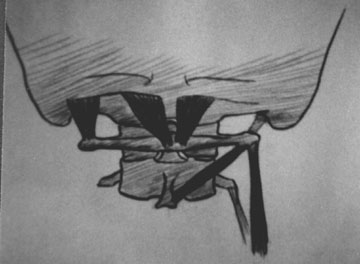
Listing Involvement: The obliquus capitis inferior corrects the anterior displacement of the transverse process of atlas upon rotation and may be inactive if the atlas is misaligned, but no rotation is present The obliquus capitis inferior muscle can also be involved in certain axis listings (to be discussed later) and this must first be considered and ruled out before resolving the atlas analysis. Osseous palpation of the transverse processes can be used in conjunction with the obliquus capitis inferior to confirm (or oppose) the student's findings.
Working Sensation: The working obliquus capitis inferior muscle is characterized as a flattened supple cord, most often interpreted to only a notable degree or moderately firm. This slender, fleshy muscle can be difficult to detect.
Note: The kinetic muscle check, discussed later, is sometimes used to
establish location and distinction of this inconspicuous band.