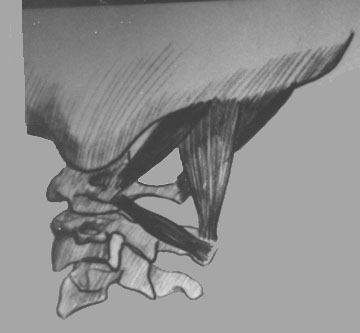
The protection of the central nervous system by osseous strutuces such as the skull and vertebrae suggest its importance to the organism. It is no surprise then that the vertebrae are knit together by many tough ligamentous structures and stabilized by hundreds of small muscles.*
The muscles which attach directly to the vertebral processes are stretch sensitive due to their inherent muscle spindles and sensory innervation. The mechanism which causes the muscle to respond is called the stretch reflex, i.e. misalignment occurs, the central nervous is system informed and consequently commands contraction of the stretched muscle or muscles. These muscles are attempting then to correct the misalignment by pulling toward the proper positioning of the joints. The method of analysis of these muscles is palpation. Palpation is both natural and convenient as the Chiropractor uses his hands for survey and evaluation of the musculature.
Here a muscle is said to be working if it exhibits increased tension comparable to the muscles surrounding the vertebra, (particularly identical muscles). There is no sound pathological explanation for a muscle to "spasm" on segmental level while other surrounding muscles are not similarly affected.
There are those that simplictically propose that the subluxated vertebra causes the "spastic" muscle and it is this which in turn holds the vertebra out of place. Now spasm can and does occur in the postural muscles and can affect vertebral placement but does not occur segmentally. In fact, muscular tension (above that of normal tone), can be due to a number of things, such as emotional strain, guarding spasm the torticollis of whiplash), fatigue, etc., but all of these things, including Vertebral Subluxation, cause increased muscular tension in more than just one tiny muscle. A region of muscles could be affected or a relay of muscle bands; but the independent action of one muscle band upon the individual process of a vertebra is a phenomenon which is clearly physiologic in nature and should be interpreted by the Chiropractor as a healthy or positive action or defense mechanism (at least). The purely mechanical imbalance of muscle lengths (due to a long standing Vertebral Subluxation), may contribute to the chronic fixation, only in that the apparent "adapted:" length of the fibers may cause instability upon correction of the misalignment.
As the body tries to accomplish the correction of a Vertebral Subluxation
by the action of specific vertebral muscles, the tone of those same muscles
will be increased above the "normal" tone of the surrounding musculature.
The correction of the misalignment may occur, either by the natural introduction
of force as the spine is moved through the normal range of motion during
daily activity of the patient or as the result of an adjustive force introduced
by the Chiropractor. In both circumstances it is ultimately the body of
the patient which determines how normal juxtapositioning occurs. The muscles
are only one gauge of correct joint position. Tendons, ligamentous structures,
joint capsules, cartilage and osseous structure inherently determine juxtaposition
by their size, position and anatomical construction. Structures such as
the joint capsule, rich in sensory receptors, feed joint-position information
to the brain. And it is the brain and spinal cord that ultimately decide
where the vertebra was designed to be or what is the best position of the
vertebra in relation to the surrounding vertebrae (with structural and
functional considerations).
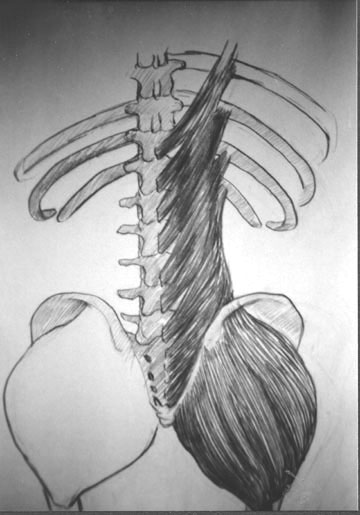 Kinesthetic, proprioceptive and equilibrating receptors feed the necessary
sensory information to the brain, which pools the data and then instantly
determines the appropriate muscular response. And it is the muscles
that are actively utilized to perform and guard such positioning.
Using palpation we can "intercept" the resulting commands and be the beneficiaries
of the brain’s knowledge of its own biomechanical needs.
Kinesthetic, proprioceptive and equilibrating receptors feed the necessary
sensory information to the brain, which pools the data and then instantly
determines the appropriate muscular response. And it is the muscles
that are actively utilized to perform and guard such positioning.
Using palpation we can "intercept" the resulting commands and be the beneficiaries
of the brain’s knowledge of its own biomechanical needs.
The tone of these muscles is available (by palpation) information about the position of the vertebrae and the intentions of the nervous system. The vertebral muscles are "working" for the correction of the subluxation and therefore telegraphing information to the Chiropractor. Palpation reveals the location of the working muscles which in turn describe the position of the subluxated vertebra and subsequent line of correction, (surpassing our crude attempts to collect data concerning the Vertebral Subluxation without the information from muscle palpation). The Chiropractor interprets the intentions of a working muscle, i.e. what direction can these muscles be pulling and what is the basic line of correction of the misalignment.